
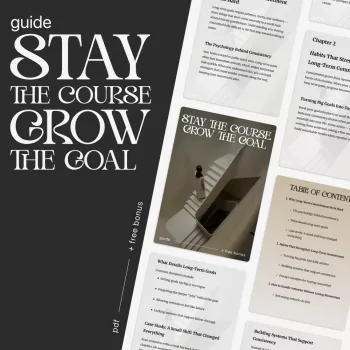
Long-term goals rarely move forward in a straight line. A busy week, a missed milestone, or a change in priorities can leave you wondering whether to keep going. You can. Commitment does not require a perfect routine; it means returning to what matters and adjusting your plan when life changes. Our Stay the Course, Grow the Goal printable self-growth guide offers a place to make that return more intentional. For more guidance, see The Neuroscience of Goals and Behavior Change – PMC – NIH.
Begin with one long-term goal, not a plan to overhaul every part of your life. Write down what you want and why it matters to you now. Your reason may change over time, but naming it gives you something to revisit when the initial excitement wears off. For further reading, see 7 Ways You Can Achieve Your Professional Development Goals.
It also helps to separate the outcome you hope for from the actions you can choose. “Finish a book by December” depends on more than any single work session. “Build a writing practice” gives you a way to participate in the goal this week, even if the final deadline needs to move. You can keep the larger ambition in view while asking a more useful question: What can I do next? A printable guide can be a convenient place to return to that question as your motivation and circumstances change.
A distant goal becomes easier to approach when you give it an ordinary-week action. If you want to write regularly, that might mean sitting down to write for 20 minutes twice a week. If you want to learn a skill, it might mean one short practice session before another commitment begins. Choose an action you can recognize and complete, rather than a vague promise to “work harder.”
Decide when and where you will do it, then plan a smaller version for a difficult day. Ten minutes at the kitchen table may be your usual step; opening your notes and writing two sentences may be your backup. The smaller version is not a consolation prize. It keeps the path back to your goal familiar. We would rather help you build a plan you can restart than encourage an ambitious schedule that only works when every week goes smoothly.
A brief weekly check-in can tell you more than a daily verdict on whether you were “good” or “bad” at your goal. Set aside a few minutes to note what happened, what got in the way, and one useful action for the coming week. Keep your observations specific: a meeting ran late, a time slot worked well, or getting started took longer than expected.
Here is one check-in you can adapt on paper. It is a suggested way to reflect, not a description of pages included in our guide.
| Question | Example response | Next step |
|---|---|---|
| What moved forward? | I worked on my goal twice. | Keep the same two time slots. |
| What made it harder? | One session conflicted with another commitment. | Choose a backup time. |
| What matters next week? | Getting started felt harder than the work itself. | Begin with a ten-minute session. |
Progress can include discovering that a method does not fit your schedule. That information helps you choose a better one. The National Institute of Diabetes and Digestive and Kidney Diseases’ guidance on changing habits likewise encourages making a plan and preparing for setbacks rather than treating them as the end of the effort.
Travel, illness, extra work, and family needs can interrupt even a realistic routine. Missing a day or a week tells you that the routine was interrupted; it does not decide what happens next. Give yourself a simple restart routine so you do not have to invent one while feeling discouraged.
First, acknowledge what changed without turning it into a judgment about yourself. Next, ask whether the goal still matters and still fits your priorities. If it does, choose one action you can take soon. You might shorten a session, move it to a different day, or ask for more time before a milestone. If your priorities have changed, you can revise the goal itself. Staying the course does not mean protecting a timeline or method that no longer serves you. It means making a thoughtful choice about how to move forward from where you are.
Our Stay the Course, Grow the Goal printable self-growth guide is a digital download focused on staying committed to long-term goals. You can keep it somewhere convenient and return to it during a weekly planning session or when your momentum feels low. Use that moment to remember why you started, consider what has changed, and decide on a next step that fits your life now.
Some goals also benefit from a resource tied to the activity itself. If your commitment is to explore more ways to style what you own, our Nightie Layer Magic digital styling eBook offers sleepwear-to-daywear outfit inspiration. Choose a resource that supports the goal you have actually named, rather than adding another project to your list.
Return to why the goal matters, choose a small action you can take now, and set a regular time to check in. You do not need to wait until you feel motivated to take the next step.
First, consider whether the goal still fits your priorities. If it does, try changing the timeline, shrinking the next step, or choosing a more workable time for it.












Leave a comment